

How to combine floral notes without them fighting each other
Anchor every floral with one non-floral base note, keep only one floral doing the heavy lifting, and finish with a single bright top note for contrast. That’s the rule. Skip it and you get “scent wars”, where two competing florals fight for attention and the result reads muddy rather than layered.
The logic sits in how fragrance actually behaves on skin. A blend develops in three stages, top, heart and base, and each stage evaporates at a different rate. Two heavy florals released at the same speed will clash because neither has room to lead. One floral plus a slower, heavier base gives the blend structure: the base holds the floor while the floral does the talking. This is sometimes called the anchor method, and it’s the single most useful technique in this entire guide.
Three quick rules to test today:
- Never pair two “heady” florals (jasmine, tuberose, ylang ylang) without a grounding base underneath.
- Pick one dominant floral and treat every other note as support, not competition.
- Add one top note for lift. Citrus, a green herb, or a light spice all work.
Try these three combinations on a test strip or a spare patch of skin before you commit to anything more elaborate:
- Rose + sandalwood + bergamot — classic, warm, wearable in most seasons.
- Jasmine + musk + pink pepper — sensual with a spiced edge, good for evening.
- Neroli + cedar + grapefruit — fresh and clean, works well for daytime.
Key takeaways
Combining floral notes successfully comes down to anchoring one dominant floral with a heavier base note and testing every blend on skin for at least an hour before judging it.
| Point | Details |
|---|---|
| Always anchor | Pair one floral with a non-floral base like musk, sandalwood or amber to prevent scent wars. |
| One dominant floral | Treat every other floral as a supporting note, never let two heady florals compete directly. |
| Follow a ratio | Use a 3:2:1 or 30/50/20 top:heart:base split and start with a small test batch. |
| Wait before judging | Give layered blends at least an hour, and bottle mixes 24 to 48 hours, before evaluating. |
| Moisturise first | Apply unscented lotion before spraying to extend wear time on skin. |
| Test with decants | Theperfumesampler’s 2ml, 3ml and 5ml decants let you compare several floral pairings before buying a full bottle. |
Table of Contents
- How perfume structure shapes floral note combinations
- Pairing florals with other fragrance families
- Two ways to build a floral blend: bottle mixing and skin layering
- Making floral blends last longer
- Testing your blend properly: how skin chemistry changes everything
- Eighteen floral blend recipes to try right now
- Common mistakes and safety notes when blending florals
- Testing floral combinations with decants: a practical workflow
- Why iterative testing beats guesswork
- Try samples before you commit to a full bottle
- Frequently asked questions
- Sources
How perfume structure shapes floral note combinations
Floral notes don’t behave the same way twice. How they sit in a blend depends entirely on where they fall in a perfume’s structure and which floral family they belong to. Get this wrong and even a well-chosen pairing can smell lopsided within twenty minutes of application.
A fragrance unfolds in three layers. Top notes give the first impression and fade fastest, usually within the first fifteen to thirty minutes. Heart notes, sometimes called middle notes, form the main body of the scent and tend to dominate the first few hours. Base notes are the slowest to develop and the reason a fragrance still has presence after four or five hours. Most florals sit in the heart, which is exactly why combining two of them without support so often goes wrong, both are trying to be the main character at the same time.
Floral subfamilies matter just as much as timing. Delicate florals like freesia or lily of the valley are light enough to sit near the top of a blend. Fuller florals such as rose and jasmine anchor the heart. Dense, heady florals including tuberose and gardenia carry so much weight they need careful handling or they’ll dominate everything around them, a pattern Eden Perfumes confirms when categorising florals by weight for layering purposes.
| Floral family | Typical weight | Volatility | Example notes |
|---|---|---|---|
| Soft florals | Light to medium | Fast to moderate | Freesia, lily of the valley, violet |
| White florals | Medium | Moderate | Jasmine, orange blossom, magnolia |
| Green florals | Light | Fast | Lily, hyacinth, muguet |
| Heady white florals | Heavy | Slow, long-lasting | Tuberose, gardenia, ylang ylang |
| Oriental florals | Heavy | Slow | Rose combined with amber, spice, resin |
Understanding this table changes how you shop. A soft floral needs almost nothing to prop it up. A heady white floral needs a serious anchor or it will overwhelm everything sprayed near it, including whatever you layered underneath.
Pairing florals with other fragrance families
Different fragrance families pair with florals in different ways, and knowing which bridging note connects two families is the difference between a blend that reads as one coherent scent and one that reads as two perfumes sprayed on top of each other.
Citrus and florals work because citrus supplies exactly what florals lack: sharp, immediate brightness. The trouble is that citrus fades within the first half hour, leaving the floral to carry on alone. Neroli acts as a natural bridge here since it’s technically a citrus blossom but smells floral enough to soften the transition. Try bergamot with rose and a touch of neroli, or grapefruit with jasmine and petitgrain for something greener.
Woody bases are the most reliable anchor for almost any floral, which is why so many commercial florals lean on sandalwood or cedar. Wood is slow, warm and rarely competes for attention, it simply sits underneath and lets the floral lead. Light woods like cedar work particularly well as a bridge because they’re neither too heavy nor too sweet. Rose with sandalwood and a whisper of amber is a dependable combination; jasmine with cedar and vetiver gives a drier, more grounded result.
Spices add complexity without stealing the show, provided you pick the right one. Pink pepper and cardamom both act as excellent bridges between florals and warmer bases because they carry a faint sweetness that echoes the floral while adding depth the floral alone doesn’t have. Combining floral and spicy notes works best when the spice is used sparingly, jasmine with pink pepper and a light musk reads as elegant, while the same jasmine with too much clove or cinnamon can tip into something closer to a dessert.
Gourmand notes such as vanilla, tonka bean or praline pair surprisingly well with heavier florals because both have a rounded, soft quality that smooths any sharp edges. Vanilla acts as a natural bridge into almost any floral, particularly rose and ylang ylang. The risk is sweetness overload, so keep the gourmand note as a supporting player rather than a co-lead.
Green and herbal notes bring texture rather than sweetness. Basil, fig leaf and green tea all sit close enough to the floral family that they blend without a bridge, but they also cool a blend down, which is useful if your floral leans heavy or heady. Lily of the valley with green tea and a light musk gives something crisp and almost aquatic; jasmine with fig leaf and cedar leans more sophisticated.
Across every family, the same intensity rule applies. Match a light floral with a light supporting note and a heavy floral with a heavier one. Pairing two heady materials, whether that’s two florals or a heady floral with an equally heavy oud, almost always produces a blend that smells congested rather than rich. When in doubt, pick contrast over similarity, a light top note against a dense floral base reads more interesting than two dense notes stacked on each other.
Two ways to build a floral blend: bottle mixing and skin layering
There are two practical workflows for combining florals, and which one you choose depends on whether you want a reusable formula or a one-off effect for a single wear.
Workflow one: mixing in a bottle
- Start with a small test batch, no more than 10 to 12ml, so a bad ratio doesn’t waste materials.
- Follow a top:heart:base ratio, either the 3:2:1 rule or a 30/50/20 split, as Essencemixer recommends for beginners working with floral blends.
- For a 12-drop test batch, that’s roughly 4 drops top, 6 drops heart, 2 drops base. Scale proportionally for a 100-drop batch: around 30 top, 50 heart, 20 base.
- Mix your base note first, then add the heart, then the top. Cap and shake gently.
- Let the blend rest, ideally 24 to 48 hours, before testing. Raw mixes often smell sharp or unbalanced straight after blending and need time for the materials to settle.
- Test on a strip, then on skin, before adjusting the ratio.
Workflow two: layering on skin
- Apply your base or anchor scent first, on pulse points such as wrists, neck and inner elbows.
- Wait roughly 60 seconds before applying the floral layer, giving the base time to settle rather than mixing wet-on-wet, a timing detail Eden Perfumes specifically recommends for layering florals.
- Spray the floral layer over or near the same pulse points, don’t rub your wrists together, friction breaks down the fragrance’s molecular structure and dulls the top notes.
- Add a top note last, in smaller quantity, closer to collarbone or hair if you want a lighter trailing effect.
- Leave the blend for at least an hour before judging it, since skin chemistry changes how a scent reads compared with the bottle.
Pro Tip: Judge a blend by its drydown, not its first five minutes. Almost every floral combination smells sharp and slightly chaotic straight after application because the top notes haven’t settled. The real test is what’s left after 45 minutes to an hour, that’s the scent you’ll actually wear all day.
Making floral blends last longer
Fixatives are what stop a beautiful floral blend from disappearing an hour after you spray it. They work by slowing evaporation, heavier, less volatile molecules physically hold onto the lighter floral molecules and release them more gradually, stretching a scent’s life from a couple of hours to most of a day.
A handful of materials do this job reliably. Musk is the most versatile, it’s neutral enough not to compete with almost any floral and adds a soft, skin-like warmth underneath. Sandalwood brings creaminess and works especially well with rose, jasmine and ylang ylang. Amber adds richness and warmth, better suited to heavier florals or blends meant for cooler weather. Orris root, extracted from iris, is subtler and slightly powdery, a good choice when you want depth without adding obvious warmth. Classic floral formulations often lean on patchouli, vetiver or orris root specifically because these materials add both depth and stability, sometimes making up as little as 5 to 10% of a blend while doing a disproportionate amount of the longevity work.
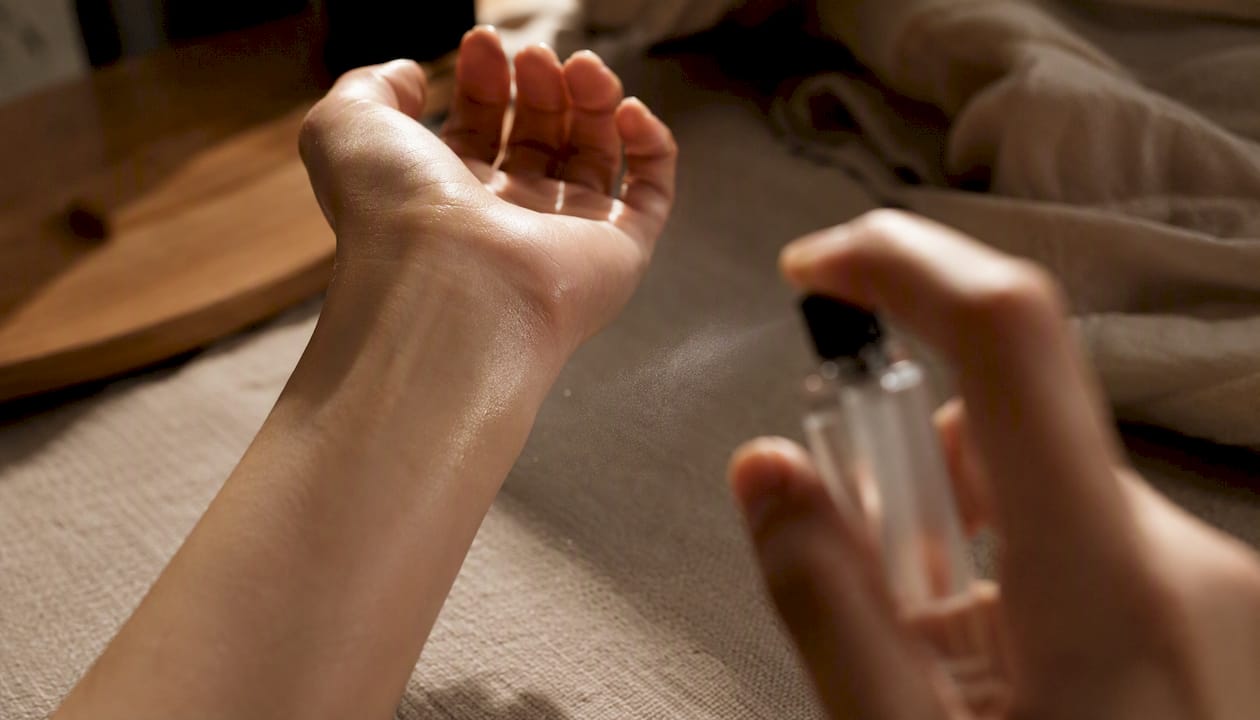
Application technique matters almost as much as the ingredients. Fragrance clings longer to hydrated skin, so applying an unscented moisturiser before spraying genuinely extends wear time, dry skin evaporates fragrance faster because there’s nothing for the oils to bind to. Apply to pulse points, wrists, neck, behind the ears, where body heat helps the scent project gradually rather than all at once.
Concentration is the other lever. An eau de toilette (EDT) typically carries less concentrated oil than an eau de parfum (EDP), which in turn is lighter than a parfum or extrait. If you’re building a floral blend to last through a full working day, an EDP or parfum concentration, combined with a fixative-heavy formula, will outperform an EDT every time, though EDTs remain the better choice when you want something lighter for layering under other scents.
Testing your blend properly: how skin chemistry changes everything
A blend that smells perfect on a test strip can smell completely different an hour after it hits your skin, and that gap catches out almost everyone who starts experimenting with floral combinations.
Part of the problem is your own nose. Olfactory fatigue sets in after continuous exposure to the same scent, your brain essentially stops registering it, which is why a blend can seem to “disappear” even though anyone standing next to you can still smell it clearly. Rotating between multiple test strips and stepping away for a few minutes resets your sense of smell and gives you a more honest read.
Timing matters just as much as fatigue. In the first five minutes, you’re smelling almost pure top notes, sharp, volatile, and not representative of how the blend will ultimately wear. Between 30 and 60 minutes, the heart notes take over and this is usually when a floral blend reveals its true character, whether the florals are working together or fighting. By the three to four hour mark, you’re into base note territory, this is where fixatives either prove their worth or the blend fades to nothing.
At each stage, it helps to note three things: how intense the scent feels compared with when you applied it, how closely it matches what you were aiming for, and roughly how much longevity is left. Doing this consistently, ideally on the same patch of skin each time, turns testing from guesswork into something closer to a repeatable process. Skin chemistry itself varies from person to person, so a formula that reads beautifully on one wrist may develop slightly differently on another, don’t be discouraged if a blend that worked for a friend needs tweaking for you.
Eighteen floral blend recipes to try right now
Each recipe below lists two or three notes, a mood, and a rough proportion you can scale to a small decant or a handful of sprays. Treat the ratios as starting points, adjust by a note or two once you’ve tested on skin.
Fresh and daytime
- Neroli, green tea, white musk — spring morning — 3:5:2
- Freesia, bergamot, cedar — clean office scent — 4:4:2
- Lily of the valley, grapefruit, light amber — spring brunch — 3:5:2
- Jasmine, petitgrain, vetiver — fresh but grounded — 4:4:2
Warm and evening
- Rose, sandalwood, black pepper — dinner date — 4:5:1
- Ylang ylang, amber, vanilla — evening warm — 3:5:2
- Tuberose, musk, cedar — bold and confident — 3:4:3
- Jasmine, oud, saffron — deep evening — 3:5:2
Gourmand and sweet
- Orange blossom, tonka bean, vanilla — cosy dessert — 4:4:2
- Rose, praline, sandalwood — sweet but not sugary — 4:4:2
- Violet, vanilla, white musk — soft and comforting — 3:5:2
- Ylang ylang, coconut, amber — tropical dessert — 3:4:3
Green and herbal
- Muguet, fig leaf, cedar — sophisticated garden — 4:4:2
- Jasmine, basil, green tea — crisp and modern — 3:5:2
- Iris, green tea, orris root — powdery green — 4:4:2
Tropical and vacation
- Frangipani, coconut, sandalwood — beach holiday — 4:4:2
- Tiare flower, vanilla, amber — sunset warmth — 3:5:2
Clean and minimal
- White musk, neroli, light cedar — barely-there floral — 4:4:2
Common mistakes and safety notes when blending florals
The most common mistake is layering two heavy florals with nothing underneath to hold them apart. Tuberose and jasmine both have enormous projection, put them side by side with no anchor and the result reads congested rather than complex, each fighting to be the dominant note. The second most common mistake is trying to combine too many notes at once. Five or six materials might sound sophisticated, but most successful blends use three or four, more than that and individual notes start cancelling each other out rather than layering cleanly. The third mistake is judging too quickly, plenty of promising blends get abandoned because someone smelled them at the five-minute mark, before the top notes had even settled.
If you’re working with essential oils rather than pre-diluted fragrance oils, dilution matters for skin safety, not just for how the blend smells. Some citrus oils, particularly bergamot, are phototoxic and can cause skin reactions in sunlight, so patch test any new blend on a small area of skin and avoid direct sun exposure for a few hours afterwards if citrus is involved.
When a blend isn’t working, resist the urge to throw more ingredients at it. Change one variable at a time, swap the base, adjust the ratio, or drop one note entirely, and retest before making another change. Working with small decants rather than full bottles makes this kind of isolated troubleshooting far cheaper and far less wasteful.
Testing floral combinations with decants: a practical workflow
Decants solve the biggest practical problem in floral blending: you can’t know whether rose and sandalwood will work together until you’ve smelled them together, and buying full bottles of five different fragrances just to test one theory is an expensive way to find out.
A workable process looks like this. Order two or three decants in the notes or finished fragrances you want to test, 2ml is usually enough for a handful of trials, while 3ml or 5ml gives you more room if you’re planning several rounds of testing over a few weeks. Create two or three small test blends by layering or lightly mixing, then log what you did, which decants, in what order, how long you waited between applications, and how the blend developed over the following few hours.
A simple label works well here, something as basic as the date, the notes used, the ratio or order, and a one-line result (“rose + sandalwood, 60 second gap, reads warm and balanced by hour two”) is enough to build a record you can actually use later. Without notes, it’s easy to forget which of your last six experiments actually worked. Buying full-size bottles of every fragrance family you want to explore, white florals, woods, orientals, gets expensive fast, which is exactly the gap sample sizes are built to close.
Why iterative testing beats guesswork
Floral blending rewards patience more than talent. Most people assume there’s a formula they’re missing, some secret ratio that experienced perfumers know and beginners don’t. There isn’t. The people who get good at this simply test more combinations, more systematically, and pay closer attention to what happens after the first five minutes.
The biggest misconception I’d push back on is the idea that more notes equal more sophistication. Almost every disastrous floral blend I’ve come across started with someone adding a fifth or sixth ingredient to “finish it off”. Restraint is what separates a coherent blend from a chaotic one, one dominant floral, one anchor, one contrast note, is nearly always more wearable than an ambitious five-note composition.
A few habits genuinely speed up the learning curve:
- Keep a simple scent journal, even three lines per test is enough to spot patterns over time.
- Start with tiny batches or single-spray layering tests before committing to anything larger.
- Pick one anchor you trust, whether that’s a particular musk or sandalwood, and build outward from it rather than changing every variable at once.
The workflows and pairing logic covered in this guide build directly on the layering techniques explored in more depth elsewhere, which is worth reading alongside this piece if you want to push further into building a signature combination rather than one-off test blends.
Try samples before you commit to a full bottle
Testing floral combinations properly means smelling the actual fragrances you’re thinking of layering, not just guessing from a notes list. That’s expensive to do with full bottles and genuinely practical with decants.
Theperfumesampler sells niche and designer fragrance decants in 2ml, 3ml, 5ml and 10ml sizes, sized specifically for the kind of side-by-side testing this guide describes. A 2ml decant is enough for several layering experiments; a 5ml gives you room to test a combination over multiple days and see how it holds up in different weather or on different skin. Rather than buying five full bottles to test one theory about rose and sandalwood, or jasmine and amber, you sample all five, work out what actually blends well on your own skin, and only buy a full bottle once you know it earns the space. Read why decants make more sense than committing blind for the full case, then start building your own test set.
Frequently asked questions
What is the easiest way to combine floral notes for a beginner? Start with one floral and one anchor, something like rose with sandalwood, and add a single citrus or green top note. Two or three ingredients is plenty while you’re learning how blends develop over several hours.
Can you mix two different floral perfumes together? Yes, but only if one is noticeably lighter than the other. Layering two heavy florals like jasmine and tuberose usually clashes; pairing a light floral, such as freesia, with a fuller one, such as rose, tends to work better.
How long should you wait before judging a floral blend? Wait at least an hour before forming an opinion, and ideally check again at the three to four hour mark to see how the base notes have settled. The first five minutes are almost entirely top notes and aren’t representative of the finished scent.
What note pairs well with almost any floral? Musk is the most versatile bridging note, it’s neutral enough to sit under nearly any floral without competing, while also slowing evaporation and extending wear time.
Do floral and spicy notes actually work together? Yes, provided the spice is used sparingly. Pink pepper and cardamom both add warmth and complexity to florals like jasmine or rose without overpowering them, whereas heavier spices such as clove need a lighter hand.
Sources
The sources behind this guide cover fragrance structure, layering method and testing technique in more depth than a single article can, worth bookmarking if you want to go further into any one area.
For the mechanics of top, heart and base notes, perfume.org’s breakdown of fragrance structure is a solid reference. On the anchor method specifically, Sylvaia’s guide to layering florals without overpowering them goes into more detail than space allows here. For beginners building their first blend from scratch, essencemixer.com’s guide to floral fragrance blending and its companion piece on classic floral formulations and fixatives both offer useful proportion guidance. Eden Perfumes’ summer layering guide covers floral weight categories in more depth, and Buzz Discovers’ piece on layering and skin chemistry is worth reading on the moisturising and testing side. If you’re curious how the same layering logic applies beyond perfume, Apothecary Home’s guide to layering fragrances in a living space translates the anchor and contrast principles into candles and room sprays.
- Essencemixer
- How to layer floral fragrances for a signature summer scent - Eden Perfumes
- Layering floral notes: creating a signature scent - Buzz Discovers